Some car designs can be recognised before the badge comes into focus. A low nose, a cabin pushed towards the front, a broad rear body: the impression arrives as a whole. Rockstar's '95 Grotti Cheetah draws you into precisely that kind of recognition game. It looks familiar, but identifying the family resemblance is more interesting than declaring it a disguised version of one specific Ferrari.
The useful question is not simply “Which real car is it?” It is which details make a fictional supercar feel as though it belongs to a particular moment in automotive culture.
Start with what Rockstar actually shows
Rockstar's official GTA VI media library labels a set of images '95 Grotti Cheetah. In the reference image inspected for this article, the car has a low, wedge-like nose, a wide body, rectangular front lighting elements and pronounced horizontal treatment along its lower flanks. Its pale body and contrasting graphics sit against a warm-toned urban backdrop.
Those are observations about published artwork. They do not establish engine layout, handling, top speed or the specification of a playable vehicle. Nor does the year in a fictional model name prove that its designers followed a real manufacturer's model-year changes exactly.
Our reading of the influences is independent visual interpretation. We found no statement in the official material reviewed that attributes the design to a particular Ferrari. We are not presenting a manufacturer collaboration or an officially confirmed inspiration.
Why the Testarossa family is the natural comparison
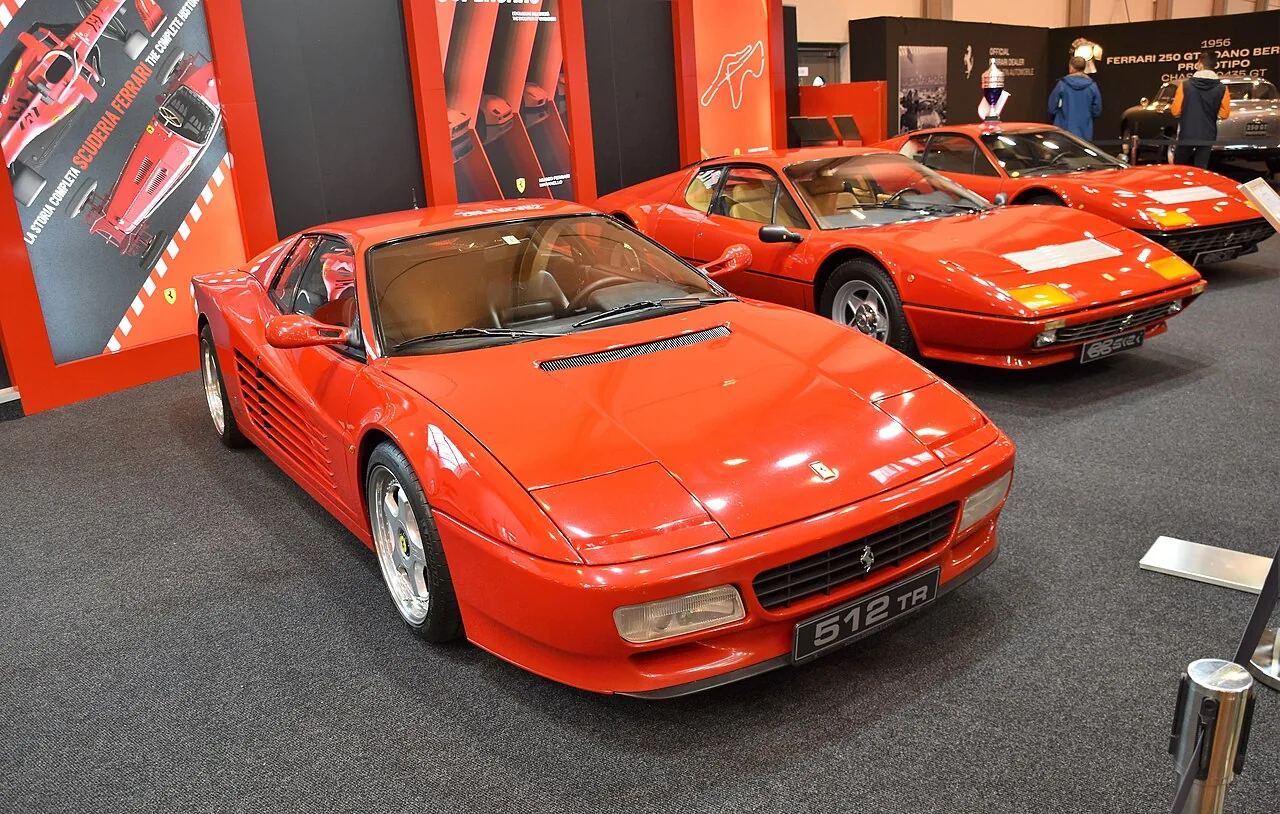
The strongest connection is the relationship between the broad rear body, low front and horizontal side detailing. That combination invites comparison with Ferrari's Testarossa family: the original Testarossa, the later 512 TR and the final F512 M.
Ferrari's own account of the three cars places the Testarossa's debut in 1984. It explains that moving the radiators to the sides shaped the car's width and the distinctive intakes and strakes. The 512 TR followed in 1991, while the F512 M arrived in 1994 and replaced the earlier cars' pop-up headlamps with fixed units.
That history matters because it stops the comparison becoming a game of matching isolated parts. The Testarossa's identity was built around proportion and repeated horizontal lines. A fictional design can echo that visual structure even when its lamps, bumpers or trim do not correspond neatly to one production model.
The '95 name does not settle the argument
There is an understandable temptation to read “'95”, look at Ferrari's timeline and conclude F512 M. The dates make that an interesting comparison. They do not make it a confirmed answer.
The sensible approach is to look at the family as an evolving design language. Compare the nose and the treatment around the lamps. Then look at how the side surfaces lead towards the rear wheels, and how much visual weight sits behind the cabin. Different details may suggest different points in the Testarossa lineage.
Other Italian wedges can be useful comparisons for the broader silhouette. A low bonnet and a dramatic stance are not exclusive to one marque. Without an official attribution, however, assembling a precise shopping list of supposed donor parts would give the interpretation a certainty it has not earned.
The photograph accompanying this article is a real Ferrari 512 TR, selected as a reference for that discussion. It is not a picture of the Cheetah and should not be read as proof of a one-to-one match.
Why this shape works so well on screen
Our view is that these older supercar forms offer something particularly useful to a visual storyteller: they communicate before they explain. A strong wedge and an emphatic rear stance create a legible outline. You can recognise the type of car from a distant shot without reading a model name.
They also carry a productive tension. The shape feels extravagant, yet its major gestures are simple enough to remember. A player does not need an encyclopaedic knowledge of Ferrari history to understand the appeal. Learning about the real cars can come afterwards, turning recognition into curiosity.
That is where fictional cars become interesting beyond a checklist of resemblances. The design can act as an introduction to an era rather than a substitute for the real machine. Look back from the Cheetah to a 512 TR and a familiar outline begins to reveal engineering decisions, changes in fashion and the compromises behind a striking silhouette.
Look again, rather than stop at the badge
The '95 Cheetah is a good starting point for that journey. The Testarossa family is a convincing visual reference; any claim that one particular version is the officially confirmed basis goes further than the sources reviewed here support.
Open Rockstar's gallery, then compare the real Ferrari photograph and the manufacturer's history. Notice what aligns, what differs and what remains uncertain. The most rewarding answer is not a triumphant badge swap. It is a better understanding of why a car can feel familiar before you have ever driven it.
For another route from a screen to an automotive obsession, read why the R34 Skyline became a gaming icon. The Revmarket Dispatch follows more connections like these, alongside real-world cars and ownership stories.
Research-led editorial prepared with AI assistance and checked against the linked sources. No first-hand road test or gameplay test is claimed.
More from Digital to Reality